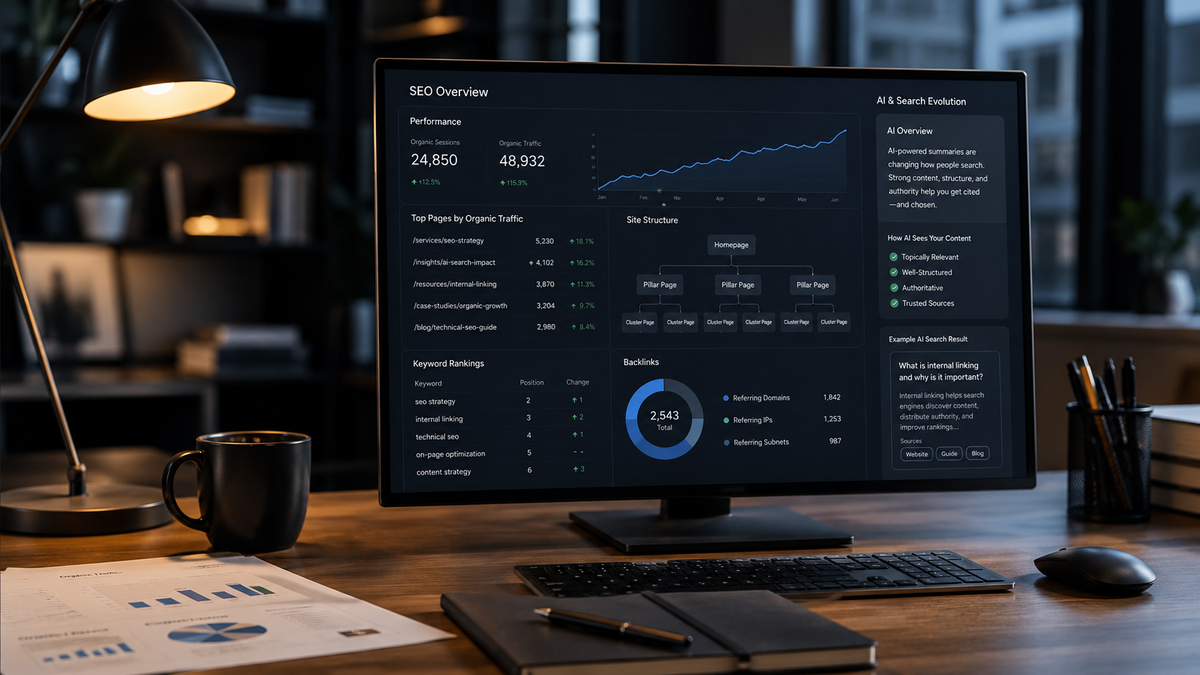

For years, search visibility mostly meant earning a place on a results page and winning the click. That model is being compressed into something smaller and more ruthless: the answer itself. Google says its AI features in Search, including AI Overviews and AI Mode, can use "query fan-out" to run multiple related searches and assemble supporting links from a broader set of pages than a classic query might surface. OpenAI says ChatGPT search delivers timely answers with links to relevant web sources. Microsoft now gives site owners reporting on when their pages are cited inside AI-generated answers across Copilot, Bing AI summaries, and partner integrations. In plain English, businesses are no longer competing only for traffic. They are competing to become the source an AI system trusts enough to cite.
That shift is exactly why GEO matters. The term comes from academic work on "Generative Engine Optimization," and the original KDD paper reported that optimization strategies could lift visibility in generative engine responses by up to 40%, with results varying by domain. A later 2025 arXiv study found that AI search systems differ meaningfully in freshness, source diversity, phrasing sensitivity, and the weight they place on third-party versus brand-owned content. So GEO is not just a buzzword tacked onto SEO. It is the practical discipline of helping AI-driven discovery systems understand, trust, and reuse your content accurately.
Search is moving inside the answer
Consumer behavior has already started to move in that direction. Bain reported in early 2025 that about 80% of search users rely on AI-written summaries for at least 40% of their searches, and that roughly 60% of searches on traditional engines now end without the user progressing to another destination. Bain also estimated that this behavior was reducing organic web traffic by 15% to 25%. Microsoft Clarity described the same phenomenon as "zero-click AI experiences," where a brand's content shapes the answer before a visit ever shows up in analytics.
That does not mean websites stop mattering. It means their job changes. Adobe reported that traffic from AI sources to U.S. retail sites grew 393% year over year in the first quarter of 2026, and that those visitors showed stronger engagement than non-AI traffic, spending more time on site and viewing more pages. The implication is not that every business should chase raw AI referral volume today. The implication is that answer engines are becoming a meaningful discovery layer, and the visits they do send can be highly qualified.
For a consulting or service business, that is a serious strategic change. The old game let you compete after the click, once a prospect landed on your site. The new game often compresses that evaluation step. If an AI system already summarizes who you help, what you do, where you work, what makes you credible, and whether you are a fit, the business that gets surfaced first often becomes the default option before the prospect ever opens a new tab. That is why GEO is not a side project. It is reputation, search, content strategy, and technical hygiene converging in one place.
Why GEO is not just SEO with a new label
There are two bad takes in this market. The first is that GEO is a total replacement for SEO. The second is that nothing has changed and everyone should keep doing exactly what they were doing in 2022. Google's own position cuts through both extremes: it says the best practices for SEO still apply to AI features in Search, there are no extra requirements to appear in AI Overviews or AI Mode, and no special optimization is necessary beyond sound technical SEO and helpful, reliable, people-first content. Google even says that, from its perspective, "AEO" and "GEO" advice for Google Search is still fundamentally SEO.
But Google also makes clear that AI search experiences do not work exactly like ten blue links. Its generative features are rooted in retrieval-augmented generation, grounded in Google's core Search index and ranking systems, and they may use different models and techniques that produce different responses and different supporting links. OpenAI's search experience blends a conversational interface with up-to-date web sources and uses third-party search providers plus partner content. Microsoft's AI ecosystem is explicit that citation visibility now matters alongside traditional discoverability. So the foundation is still SEO, but the output surface is different enough that businesses have to optimize for citation, extractability, and trustworthiness inside generated answers, not just for ranking position.
That is the most useful way to think about GEO: not as a replacement for SEO, but as SEO plus answer-readiness. Your pages still need to be crawlable, indexable, and technically clean. They also need to be easy for a model to parse, confident enough to cite, and specific enough to reuse without guessing. If traditional SEO helped you get into the library, GEO helps you become the page the librarian actually pulls off the shelf.
How AI systems decide who gets cited
The first gate is still technical eligibility. Google says a page must be indexed and eligible to appear in Search with a snippet in order to be shown as a supporting link in AI Overviews or AI Mode. OpenAI says that if a site opts out of OAI-SearchBot, it will not be shown in ChatGPT search answers, even though it may still appear as a navigational link. That means GEO starts with very unglamorous work: crawlability, snippet eligibility, robots rules, workable HTML, and a site structure that search systems can actually process.
The second gate is clarity. Microsoft's guidance for AI search says clear headings, tables, and FAQ sections make content easier for AI systems to reference accurately. Its content guidance also stresses descriptive titles, aligned H1s, question-and-answer formatting, lists, comparison tables, and self-contained phrasing that still makes sense when pulled out of context. This matters because answer engines do not "read" a page the way a human does; they break content into smaller usable pieces and assemble a response from those chunks. If your most important point is buried in a wall of text, hidden in an accordion, or trapped inside an image, your odds drop.
The third gate is originality and proof. Google says unique, non-commodity content is likely to matter more in the long run than most tactical tweaks, and specifically says a unique point of view and first-hand experience stand out more than recycled summaries. Microsoft says examples, data, and cited sources help build trust when content is reused in AI-generated answers. That is a direct signal to businesses: generic "ultimate guides" are weak fuel for AI search. First-hand insights, real examples, specific claims, and evidence-backed pages are better fuel.
The fourth gate is freshness and consistency. Microsoft says regular updates help AI systems reference the most current version of your content, and recommends IndexNow to notify participating search engines when content is added, updated, or removed. Google says its AI features use links from the Search index and that helpful page experience, strong structure, and high-quality supporting media all still matter. Put differently, you are feeding living systems, not static directories. If your credentials, pricing model, offer details, service areas, or process pages are vague or stale, AI answers are more likely to ignore you, misstate you, or cite someone clearer.
There is also a broader authority layer outside your own website. One 2025 arXiv study found that AI search systems showed a strong bias toward earned media and third-party authoritative sources over brand-owned and social content. That does not mean your website is less important. It means your site needs to be the clean source of truth, while reviews, press mentions, interviews, guest appearances, case studies, partner references, and other off-site signals help confirm that you are credible enough to recommend. For smaller firms, that is actually encouraging: you do not need to be the biggest brand, but you do need a web footprint that corroborates your expertise.
What businesses should do now
The smartest first move is to build a source-of-truth layer on your site. Every core service should have a page that states, in plain language, what the service is, who it is for, what problem it solves, how the process works, what outcomes a client should expect, and what makes your approach credible. Those pages should not be fluffy. They should be specific, structured, and written the way a prospect actually asks the question. Google says AI systems can understand a range of phrasings without you obsessing over every keyword variation, but it also stresses that pages should be organized clearly for humans. Microsoft's guidance points in the same direction: clarity beats cleverness.
The second move is to publish "extractable" content around your services. That means pages built for definition, comparison, objection-handling, and decision support. Think in terms of pages that answer questions like: What is GEO? How is GEO different from SEO? Who needs GEO first? What does AI search optimization actually include? What should a local business fix before chasing AI visibility? Microsoft explicitly recommends headings, FAQ sections, lists, and tables because they make citation easier. Google says there is no ideal page length and no need to "chunk" content artificially, so the real target is not short content. It is content with clean structure and clear idea boundaries.
The third move is to strengthen credibility signals that AI systems can actually use. Add author bylines where relevant. Show specific proof. Use examples, case-study language, before-and-after context, testimonials with real detail, and cited claims where you make factual assertions. Google says unique point of view and first-hand experience are differentiators. Microsoft says evidence, data, and cited sources build trust when content is reused in AI answers. If your site sounds like anybody could have written it, an AI system has little reason to trust it over the clearer, more substantiated alternative.
The fourth move is operational consistency, especially for local and service-area businesses. Google says AI responses can include information about local businesses and recommends products like Google Business Profiles to help products and services stay visible in AI responses and Search. Microsoft says accurate business information is especially important for location-based AI answers and recommends Bing Places for Business so address, hours, and contact details remain current and eligible for inclusion. A lot of "AI optimization" for local businesses is really just disciplined entity management: one business name, one phone number, one service taxonomy, one coherent story everywhere.
The fifth move is to stop chasing nonsense. Google now explicitly says its spam policies apply to attempts to manipulate generative AI responses in Search. It also says to ignore many of the shortcut tactics being sold into the market, including unnecessary "chunking," inauthentic mentions, and AI text files like llms.txt as a supposed requirement for Google visibility. It specifically says structured data is still useful for overall SEO and rich results, but there is no special schema markup required for generative AI search. That is important because a lot of GEO advice right now is just repackaged superstition. The reliable path is still strong content, clean structure, technical accessibility, and believable proof.
There is also a forward-looking reason to clean up your site now: search is becoming more agentic. Google notes that browser agents may gather data by analyzing screenshots, inspecting the DOM, and interpreting the accessibility tree. That means the future of search visibility is not just text retrieval. It is whether automated systems can understand your site well enough to act on it. A messy site with hidden key information, weak accessibility, and inconsistent page meaning is not just bad UX anymore. It is bad machine readability.
How to measure visibility when the click never comes
Measurement is where most businesses will lag, because classic SEO dashboards were built around impressions, rankings, clicks, and sessions. In AI search, influence can happen before the visit. Microsoft's AI Performance report now shows total citations, cited pages, grounding queries, and visibility trends across AI experiences. Microsoft Clarity's citations view extends that idea by connecting bot crawling and indexing with citation activity and AI-referred traffic. That tells you what the new scorecard needs to include: not just whether a page ranks, but whether it gets reused, cited, and associated with commercially meaningful prompts.
For Google, the situation is less direct. Google still points site owners back to core Search practices and Search Console for technical diagnosis and performance work, rather than offering a dedicated AI-citation report comparable to Bing's. So, for now, the practical approach is blended measurement: use Search Console to monitor crawlability, indexing, queries, and page-level visibility; use Bing's AI reporting where available to see citation behavior; and watch your analytics for AI-originated sessions and conversion performance on the pages most likely to be cited. That last part is an inference from the current tooling gap, but it is the sensible one. If traffic is increasingly answer-mediated, your measurement model has to capture influence before and after the click.
This is also why early movers have an opening. Bing only rolled out public AI citation reporting in 2026, and Google's official guidance on generative AI search still centers on foundational SEO rather than a whole separate measurement stack. The market is still normalizing. That is good news for disciplined businesses. You do not need a secret technical trick. You need a clearer site, stronger proof, cleaner entity signals, fresher content, and a measurement model that treats citation visibility as a real business asset.