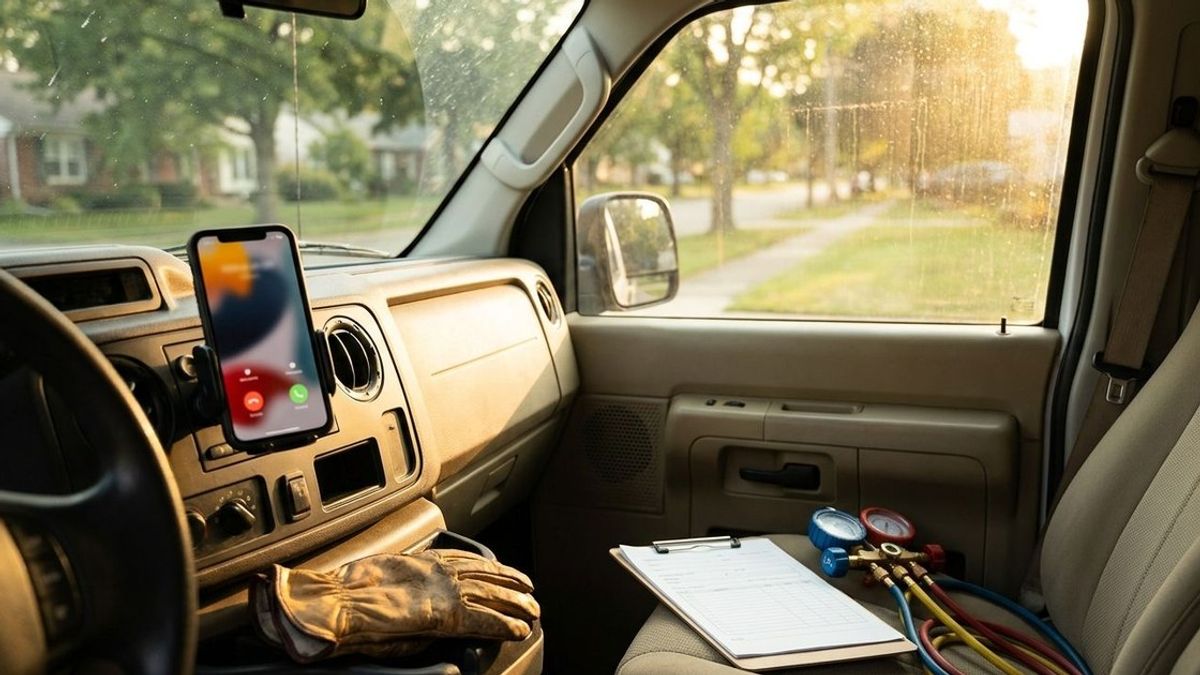
A homeowner searches "plumber near me," taps Have AI check pricing, fills in a short form, and goes back to their day. Google's AI then phones several local shops, asks what the job costs and when someone can come out, and emails back a summary.
If your line rings out, or your CSR says "we don't quote over the phone," the shop down the road gets named with a price and a time. You don't.
The short answer: "Ask for Me" (shown in Search as "Have AI check pricing") is a Google feature that calls local businesses on a customer's behalf to check price and availability. At Google I/O in May 2026, Google said it's expanding to categories including home repair, rolling out in the U.S. Google picks which businesses to call from its local search results, and you can opt out in your Business Profile settings. Being ready comes down to three gates: show up locally, answer the phone, and give the AI something usable. This is GEO / AI search in its most practical form.
What Google's "Ask for Me" (Have AI check pricing) actually is
It's an AI agent that makes real phone calls to real business lines for a shopper who asked it to. The timeline:
- January 2025: Google launched "Ask for Me" as a Search Labs experiment for auto shops and nail salons, built on the same Duplex technology Google uses for restaurant reservations (Search Engine Land). Early testers got a summary by text or email in about 30 minutes (9to5Google).
- July 2025: Google rolled AI business calling out to all U.S. Search users as "Have AI check pricing" (Google).
- May 19, 2026: In its I/O Search announcement, Google wrote: "for select categories like home repair, beauty or pet care, you can ask Google to call businesses on your behalf. These capabilities will roll out to everyone in the U.S. this summer" (Google).
The customer describes the service and timing, Google calls several nearby providers, shares the request details (which may include the customer's name), and emails the customer the quotes (Google Search Help).
Every call announces that it's an automated system calling from Google on behalf of a user (The Verge), and calls are recorded (Google Business Profile Help).
Is Google's AI calling HVAC, plumbing, and electrical shops yet?
Home repair is announced and rolling out. It isn't fully documented yet. As of mid-October 2026, Google's customer-facing help page still lists examples like auto repair, hair salons, pet groomers, wellness centers, and driving schools, and says Google is "working on quickly expanding" to more services.
But some trades are already getting these calls. Call-tracking company Invoca saw plumbing among the sharpest increases in Google AI pricing calls across its network in November 2025, months before the I/O announcement (Invoca). Plan as if it's already reaching your phones.
Is it live in my state?
Google says customer-request calls are available in every U.S. state except Indiana, Louisiana, Minnesota, Montana, and Nebraska (Google Business Profile Help). If you run trucks in West Virginia, Maryland, Virginia, or Pennsylvania, you're in scope.
Gate 1: How Google decides which shops to call
Google calls businesses that already show up in local search for that job. When the feature rolled out in 2025, a Google spokesperson said the AI chooses businesses based on traditional local search rankings, and only businesses that appear in results for the query and match the customer's criteria get contacted (Search Engine Journal).
So the shortlist comes from your local visibility. If you don't show up for "furnace repair near me" in the towns you serve, the AI has no reason to dial you.
On your Google Business Profile, check the basics: the right primary category, a services list named the way homeowners say it, the towns you'll really drive to, accurate hours, and a public number that reaches a person.
If the map pack is the weak spot, that's local SEO work, and it pays off either way. AI search now acts on local data instead of just summarizing it, the shift we covered in search is moving inside the answer.
Gate 2: Answer the phone (the expensive miss)
The biggest loss is the call nobody picks up. In Invoca's study of Google AI pricing calls from July through November 2025, 26% went unanswered on average. Plumbing businesses answered 66%, among the lowest of any industry tracked. Auto repair and tire shops answered 79% and pest control 75% (Invoca).
Google avoids calling late at night or early in the morning, so these calls land during business hours, exactly when techs are on jobs and the office is slammed.
Cover the line and test it
Decide who picks up when the office is buried: a second CSR, an answering service, or an AI receptionist for overflow. Then call your own number from an unfamiliar line, count the menu layers, and make sure call-screening or spam blocking isn't burying automated callers.
The same fix pays twice
Answer coverage matters for paid leads too, including Local Services Ads. Our breakdown of Google Ads vs Local Services Ads covers how the two work, and Google & Meta ads for home services covers how we set up the phone side of paid work. Fixing the phone before buying more clicks is the same idea behind our marketing budget guide.
Gate 3: Give the AI something it can pass along
Picking up isn't enough. Invoca found that 48% of answered calls gave Google's AI no pricing at all. That was most common in home services like pest control and plumbing, where staff said they don't give estimates over the phone and need a home visit.
That's often true in trade work, but it leaves the AI with nothing to report. Google says that if you share price and availability, the customer gets an email or text that includes your service quote (Google Business Profile Help). If you share nothing, the shop that did gets the attention.
A four-part answer your team can use
Give whoever answers the phone a simple pattern (example):
- Confirm the service. "Yes, we repair gas furnaces in [town]."
- Share the price info you're comfortable giving. "Our diagnostic visit is [your diagnostic fee], and that goes toward the repair if you go ahead." Or: "Water heater replacements typically start at [your starting price] installed."
- Give your soonest availability. "We can have a tech out [day / window]."
- Offer the next step. "They can call us at this number or book online to lock in that time."
JobNimbus, a contractor software company, recommends a similar four-part format in its guide to Google's AI calls.
"Every job is different" vs. a range
You don't have to quote blind. Share what's stable: a diagnostic fee, a "starts at" price for a defined job, or a typical range. Set those from your own job history. A no-heat diagnostic, a water heater swap, and a panel upgrade are good places to start.
Keep the phone, profile, and website saying the same thing
If your CSR, your Business Profile, and your website each say something different, the homeowner gets mixed signals. Line them up. If your site has no clear service pages or price guidance, that's a web design fix.
Should you opt out of Google's AI calls?
You can, and it doesn't have to be all or nothing.
How to opt out: In a verified Business Profile, go to More → Business Profile settings → Advanced settings. Under "Google automated calls and text messages," there are three switches: Bookings and inquiries from customers, Keep your profile up to date, and Post to your profile on your behalf. You can also just say "Please stop calling my business" when Google calls. Unverified businesses have to verify before they can opt out in settings, and Google notes you may still get occasional manual calls to confirm your info (Google Business Profile Help).
Stay in if you want more booked jobs and someone can answer with a fee or range. Opting out is reasonable if the board is full, phones are overloaded, or nobody can talk price without the owner. Or go partial: keep customer calls on and turn off "Post to your profile on your behalf." Google doesn't say whether opting out affects how you show up in Search or Maps, so don't let anyone tell you it does or doesn't.
Real Google call or scam?
Real calls say they're from Google and why they're calling. Google says it will never ask for payment, card details, or passwords, and won't promise you a special spot in its products (Google Business Profile Help). If a "Google" caller wants money to keep or boost your listing, hang up. Nobody can sell you a guaranteed spot in Google's AI calls. We can't either.
What Google has confirmed vs. what the internet is guessing
Confirmed by Google (or a Google spokesperson):
- The AI calls businesses to check price and availability for customers
- Home repair was named in the May 2026 I/O announcement for a U.S. rollout
- Businesses are chosen based on local search rankings and the customer's criteria
- Calls are disclosed, recorded, and limited to reasonable hours
- Opt-out settings and the five-state exclusion list
Not confirmed. Treat it as opinion:
- That you're excluded if your Business Profile has no prices listed
- That matching your website and profile services is a "ranking signal" for these calls
- Any "answer within X seconds or you're dropped" rule
- Exactly how the AI weighs reviews when it picks businesses
- How businesses that couldn't be reached are shown in the customer's summary
A 30-minute readiness check for your shop
- Search your top services plus your main towns. Do you show in the map pack and local results?
- Check your Business Profile categories, services, service area, hours, and phone number.
- Call your own number during business hours from an unfamiliar line. Who answers?
- Write the four-part answer for your top three to five job types and give it to whoever answers.
- Decide: stay in, partial opt-out, or opt out.
- Make sure your profile, website, and phone answers match.
- Tag Google AI calls in call tracking and, as Invoca recommends, keep them out of retargeting and callback campaigns.
How JMCG helps
We're one team for home service companies, measured on booked jobs, not clicks. For this feature, that means:
- Getting you into the local results Google's AI calls from, through local SEO and GEO / AI search
- Setting up the phone side of ads and Local Services Ads so calls get answered and tracked
- Consulting on answer coverage, call scripts, and how your team talks about price
Comparing partners? Ask how they handle AI search; our guide on how to hire a home services marketing agency has the full question list. More on marketing for home service companies.
FAQ
What is Google's "Ask for Me" or "Have AI check pricing" feature?
A Google Search feature where AI calls local businesses for a customer to check pricing and availability, then emails the customer the quotes. Calls identify themselves as automated calls from Google.
Will Google's AI call HVAC, plumbing, and electrical businesses?
Google announced home repair as a category at I/O in May 2026, rolling out in the U.S. Its help page doesn't fully list home repair yet, but Invoca data shows plumbers were already getting these calls in late 2025.
How does Google decide which home service businesses its AI calls?
Per a Google spokesperson, from traditional local search rankings: only businesses that appear in local results for the query and match the customer's criteria are contacted.
What should my team say when Google's AI calls for a price?
Confirm the service, share a diagnostic fee, starting price, or typical range, give your soonest availability, and offer a next step to book.
How do I opt out of Google's AI calls, and should I?
In a verified Business Profile: More → Business Profile settings → Advanced settings → turn off "Bookings and inquiries from customers." Or say "Please stop calling my business" on a call. Stay in if you want jobs and can answer; opt out if you can't.
Which states have Google's automated customer calls?
All U.S. states except Indiana, Louisiana, Minnesota, Montana, and Nebraska, per Google.
How can I tell a real Google AI call from a scam?
Real calls say they're automated from Google and why. Google won't ask for payment, card info, or passwords, or promise special placement.
Ready to find out what happens when Google calls your shop?
Tell us your trade, your towns, and how your phones get answered today. We'll check whether you're showing up where Google's AI is calling from, and help you tighten what your team says when it rings.